
Request a demo

From huddle to handoff to closure.

Move patient and workforce safety concerns through a clear workflow with defined ownership, coordinated handoffs, and visible progress.

Care team applauding during a huddle

Conversation to follow-through.

Frontline teams surface the concerns, barriers, and priorities that shape the shift ahead.
The workflow begins with the huddle they already hold.

  1. Start the huddle

    The unit begins the huddle it already holds. The team leads the conversation and retains its clinical and operational judgment.

  2. Bring risks into focus

    Concerns raised during the discussion become structured items organized by risk type and urgency.

  3. Set the next step

    Each action receives a named owner and due date while the conversation is still current. Responsibility becomes clear before the huddle ends.

  4. Connect the right team

    Items move to the department or leadership level positioned to take action. The original concern, context, owner, and timeline stay connected.

  5. Keep progress visible

    Open and overdue actions remain visible until they are closed. Teams can see what happens next, and leaders can see where support is needed.

One concern. Three huddles. One thread.

The unit huddle, operational huddle, and executive safety briefing stay connected through one record that carries each patient or workforce safety concern forward with its context, owner, next steps, and status intact.

Unit huddle

Surface what matters now

Frontline teams raise patient and workforce safety concerns, act on what can be handled at the unit level, and move forward what needs broader support.

5 West Medical Surgical, 7:00 AM

OPERATIONAL HUDDLE

Coordinate what crosses units

Recurring risks become visible across units, helping operational leaders align resources and remove barriers.

Medical Surgical Division, 9:15 AM

EXECUTIVE BRIEFING

Focus on enterprise action

Unresolved concerns reach senior leadership with their full context intact, enabling leaders to make decisions or provide the support required.

Executive Safety Briefing, 11:00 AM
Guidance before the huddle

Quality and safety teams know where risk is building. The huddle may not.

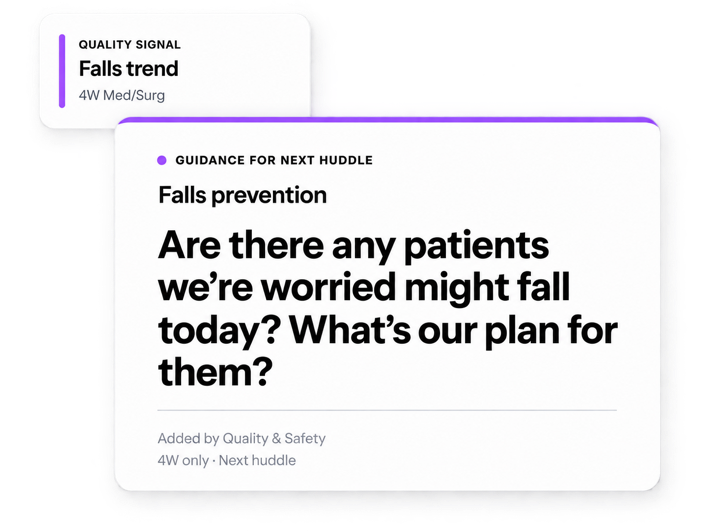
Approved quality and safety leaders can place a brief prompt into a specific unit's next huddle based on patient safety trends, census, staffing pressure, or current priorities.

  • Quality and safety spot the pattern: Falls are rising across three medical units.
  • Quality and safety write the prompt: The prompt is sent only to the units that need it, rather than broadcast across the hospital.
  • The prompt opens the huddle: The charge nurse sees the prompt when the huddle begins. Any concern the team raises becomes a clear next step with an owner and due date.

Prompts are written by approved leaders, visible to the unit, and limited to the teams that need them.

Quality signal and guidance-for-next-huddle cards showing a falls prevention promptA nurse reviewing huddle guidance on a tablet in a unit corridor
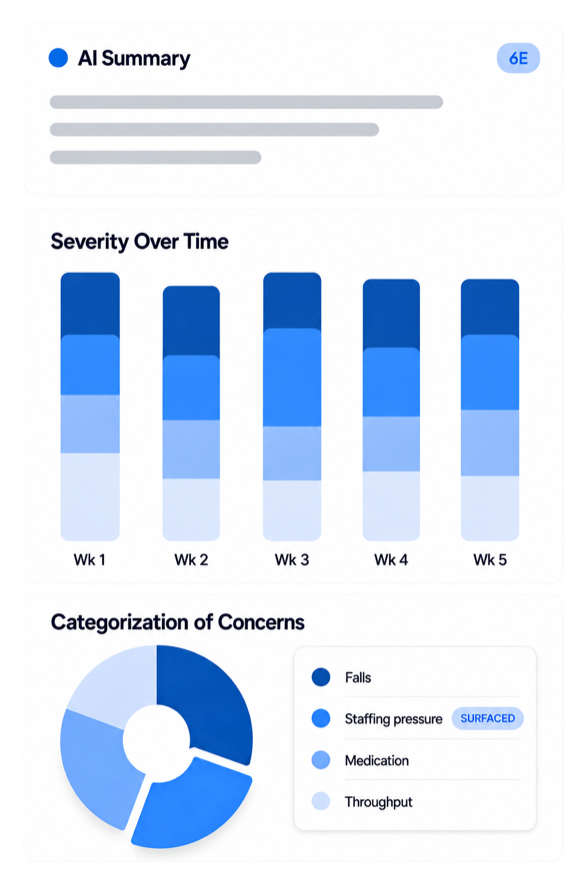
Dashboard cards showing severity over time, an AI summary, and categorization of concerns

Built on existing workflows, supported by AI.

AI organizes huddle input, categorizes risks, and surfaces recurring patterns. Clinical judgment stays with the people closest to the work.

Risk categories, routing rules, and prompts reflect how safety work is already organized.

What surfaced, what needs attention, and where patterns are emerging are available without manually compiling notes and status updates.

Less preparation. More time for safety conversations.

Keep safety work moving after the huddle.

Software that turns your daily huddle concerns into owned follow-through.

Explore more